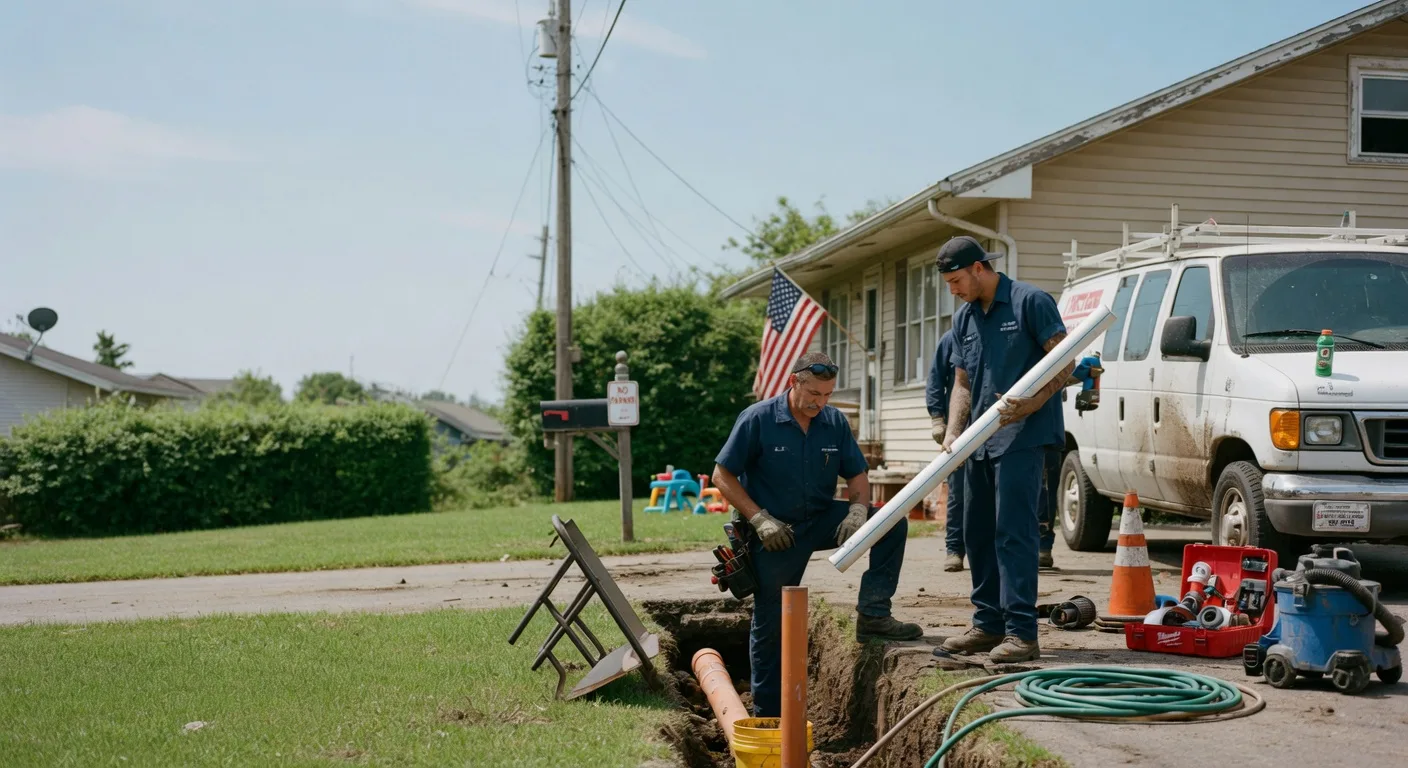
How do I know if tree roots have gotten into my sewer line?
Tree roots get into a sewer line through a hairline crack or a loose joint. Clay pipe is the usual victim because it is laid in short sections, so there is a joint every few feet for a root tip to find. Roots follow moisture, so a strand enters, thickens, and starts catching paper and grease until flow stops. Warning signs are a main line that clogs on a predictable schedule, gurgling from drains near large trees, and a cable machine that keeps stopping at the same distance. One slow fixture is rarely roots. Several drains slowing together, or a basement floor drain that rises, points to the main line where roots live. A cable with a cutting head opens a channel through the mass for temporary relief, and hydro jetting scours the pipe wall more completely, but neither seals the entry point, so the roots return. A camera inspection shows the crack or joint, how much root is present, and the pipe's condition, which decides whether periodic cutting is enough or a section needs repair. Access and the length of pipe involved drive that cost. PVC resists root entry far better than clay. For a suspected root problem in Dike, IA, Expert Plumbers Co connects you with an independent local plumber.
Prevention around trees is worth knowing about, because the root itself is rarely the whole story. Not every tree is a threat, and removing one is rarely the right first step, since the roots already in the pipe do not stop growing and the pipe's joints stay open. Willows, maples, poplars, and similar fast growers tend to be the worst for seeking out sewer lines, but any large tree in a dry spell can send roots to a pipe that holds moisture. Avoid pouring rock salt or copper sulfate products into toilets without asking a plumber first, since they can harm pipe and the wider water system. Keep records of when the line was last cut or jetted. If the intervals between clogs are getting shorter, that is a sign the root mass is thickening and a repair may soon be better value than repeated cleaning. Ask the plumber about replacement options.
How often does a main sewer line actually need cleaning?
There is no set interval that fits every house. A main sewer line in good shape, with no symptoms, does not need cleaning on a calendar. A line with a known problem often does.
The usual reasons a main line needs repeat attention are root intrusion at a clay or loose joint, grease build-up on the pipe wall, or a bellied section that holds water and collects solids. Those problems do not go away after one cleaning. Roots regrow. A belly keeps holding water. A line like that may need cleaning on a schedule that suits what is found in it.
The way to set that schedule is a camera inspection. It shows the cause, the condition of the pipe and where the trouble sits, so the interval is based on what is in the line and not a guess.
Watch for the signs: slow drains in several fixtures, gurgling, a sewage smell, or the lowest drain in the house backing up. One slow sink is usually a branch line job. Several fixtures at once points to the main.
A cable machine is often enough for roots and soft blockage. Heavy grease or scale needs hydro jetting. A failed sewer lateral needs repair, not cleaning, and cost then depends on access, the materials, how much is opened up and any permit required. If sewage is backing up, stop running water and call. Expert Plumbers Co is a referral service. We refer you to a local plumber for Drain Cleaning or Emergency Drain Cleaning in Dike, IA: (380) 262-9173.
What you notice between cleanings is more useful than the date on the calendar. Keep a simple note of when drains slow, when gurgling starts and how long each cleaning lasted. If the gap between problems keeps shrinking, the cause is getting worse and a camera inspection should come before the next cleaning. Older homes with clay or cast iron mains often show roots or scale returning within a year or two, while newer plastic mains usually stay clear much longer unless a joint has shifted or something was flushed that should not have been. A common mistake is paying for repeated cleanings without ever seeing the inside of the pipe. After a thorough cleaning and inspection, ask the plumber what the line looked like, how much was removed and when it makes sense to look again, so you leave with a plan.
What is a sewer lateral and who is responsible for repairing it?
A sewer lateral is the pipe that carries waste from your house to the main sewer line. You usually hear the term when a camera shows a crack, or when every drain in the house backs up at once.
It starts where your drain lines leave the building and runs underground to the connection with the main. Older laterals are often clay, cast iron or fibre pipe, and they fail in familiar ways. Roots work into a clay joint. The pipe sags into a belly that holds water. A section cracks or collapses. Scale narrows cast iron until little gets through.
Who repairs it depends on where the fault is and on local rules. In many places the owner is responsible for the lateral up to the property line, and sometimes all the way to the main. In others the utility owns the part under the street. Your city or sewer utility can tell you where responsibility sits for your address in Dike, IA. Ask before you assume.
Safe homeowner check: note which drains are slow, and whether it is one fixture or all of them. Stop running water and call now if every drain is backing up, or if sewage is coming up in a tub or floor drain.
A camera inspection finds the break. Cost depends on depth, access, how much must be dug or opened, the materials, and any permit. Expert Plumbers Co is a referral service. Call (380) 262-9173 and we will connect you with a plumber in Dike, IA.
Ask the plumber whether the camera run can note the distance from the cleanout to the fault, so you can tell which part of the lateral is the problem. A fault near the house, a fault at the property line and a fault under the street can each land with a different owner. Before any repair, take a screenshot or copy of the footage and keep a note of the date. Local rules may require a permit, an inspection by the building department or the utility, or notice to the sewer authority, so check before digging starts. Some utilities or cities also run programs that cover part of a lateral repair, and a few require an inspection when a property is sold. Ask your homeowner policy provider what it says about sewer line damage, because many standard policies leave it out. Older neighborhoods with mature trees tend to have more root problems, so it is worth asking about a root-resistant joint when the pipe is renewed.
Water shows up around the base of the toilet after flushing. Is that the drain or the seal?
"There is water around the base of my toilet after I flush." Water at the floor can come from three places, and only one of them is the drain.
The most common cause is a failed seal. A toilet sits on a wax ring or a rubber seal that joins it to the flange, the fitting on the floor drain. If the ring is crushed or the toilet rocks, water escapes at the base during the flush. A loose bolt, a cracked flange or a flange set too low can do the same.
A drain problem is the other case. If the toilet is partly blocked, the flush water slows and rises, and it can push out at a weak seal. Grease build-up, a bellied line holding water, or root intrusion at a clay joint can all do this.
Here is the test. If only this toilet leaks and every other drain runs clean, think seal or flange. If the bowl drains slowly, gurgles, or the tub and floor drain are also slow, think drain. If every drain in the house is backing up, the main line or sewer lateral is involved.
Safe homeowner check: Flush and watch where the first drop appears. Press the toilet by hand to see if it rocks. Check the supply line and shutoff valve for drips. Look at the bowl: does it drain quickly or slowly? Do not over-tighten the closet bolts, because porcelain cracks.
Stop running water and call now if the water on the floor smells of sewage, the toilet will not drain or the bowl rises, other fixtures are backing up, or water is coming through a ceiling below.
A cable machine is enough for a toilet blocked by a clog close to the bowl. A seal or flange job is a reset, not a drain job: the toilet is lifted and a new ring and fittings go in. If the drain keeps slowing, a camera inspection can show roots or a belly, and hydro jetting is used for grease or scale coating the pipe wall.
Expert Plumbers Co is a referral service. We connect you with an independent local plumber in Dike, IA. Call (380) 262-9173.
Ask the plumber to say whether the problem was the seal, the flange or the drain, and what they checked. Ask if the subfloor is wet or soft, since that can widen the work. Cost depends on access, the parts or materials needed, how much has to be opened up or removed, and any permit or code requirement.
Will baking soda and vinegar, or a kettle of boiling water, clear a slow drain?
You have a slow drain, so you tried baking soda and vinegar, or a kettle of boiling water. It still crawls, or the clog is back by morning. That is the usual result.
The fizz is mild. It can freshen a drain, but it does nothing to a solid clog of hair, soap scum, grease or paper. Boiling water melts grease for a moment, then the grease cools and sets again further down the pipe, where it is harder to reach. Boiling water can also soften PVC joints and crack porcelain. Hot tap water is safer than a kettle.
The real causes sit deeper: grease build-up on the pipe wall, scale in old cast iron, roots entering a clay joint on the main, or a bellied line that holds water and solids at its low point. A blocked vent stack can also make a drain sluggish and gurgling, which looks like a clog but is an air problem.
Count the affected drains. One slow fixture usually means a hair, soap or grease clog in that fixture or its branch. If the tub, sinks and toilets all run slow together, or you hear gurgling after a flush, the trouble is in the main line or vent, and no kitchen remedy will reach it.
Safe homeowner check: Remove the stopper or strainer and clear hair and residue by hand. Try a plunger with a good seal. Run hot tap water, not boiling. Check whether other fixtures are slow. Avoid stacking store-bought chemical cleaners, which can sit in a standing pipe.
Stop running water and call now if more than one fixture is backing up, if dark water is rising in a tub or floor drain, if you smell sewage, or if water comes up when you flush or drain the washer.
A cable machine is usually enough for a clog in a single branch. Hydro jetting is the better tool when grease or scale coats the pipe wall. A camera inspection is the right step when the drain clears and slows again within days, since that pattern points to a belly, roots or a damaged section.
Expert Plumbers Co is a referral service. We connect you with an independent local plumber in Dike, IA. Call (380) 262-9173.
Tell the plumber what you already tried. Ask what they found in the line, not only that it was cleared. The scope depends on access to the pipe, whether a fixture has to be removed, the pipe material, and whether the cause is a simple clog or damage that needs repair.